
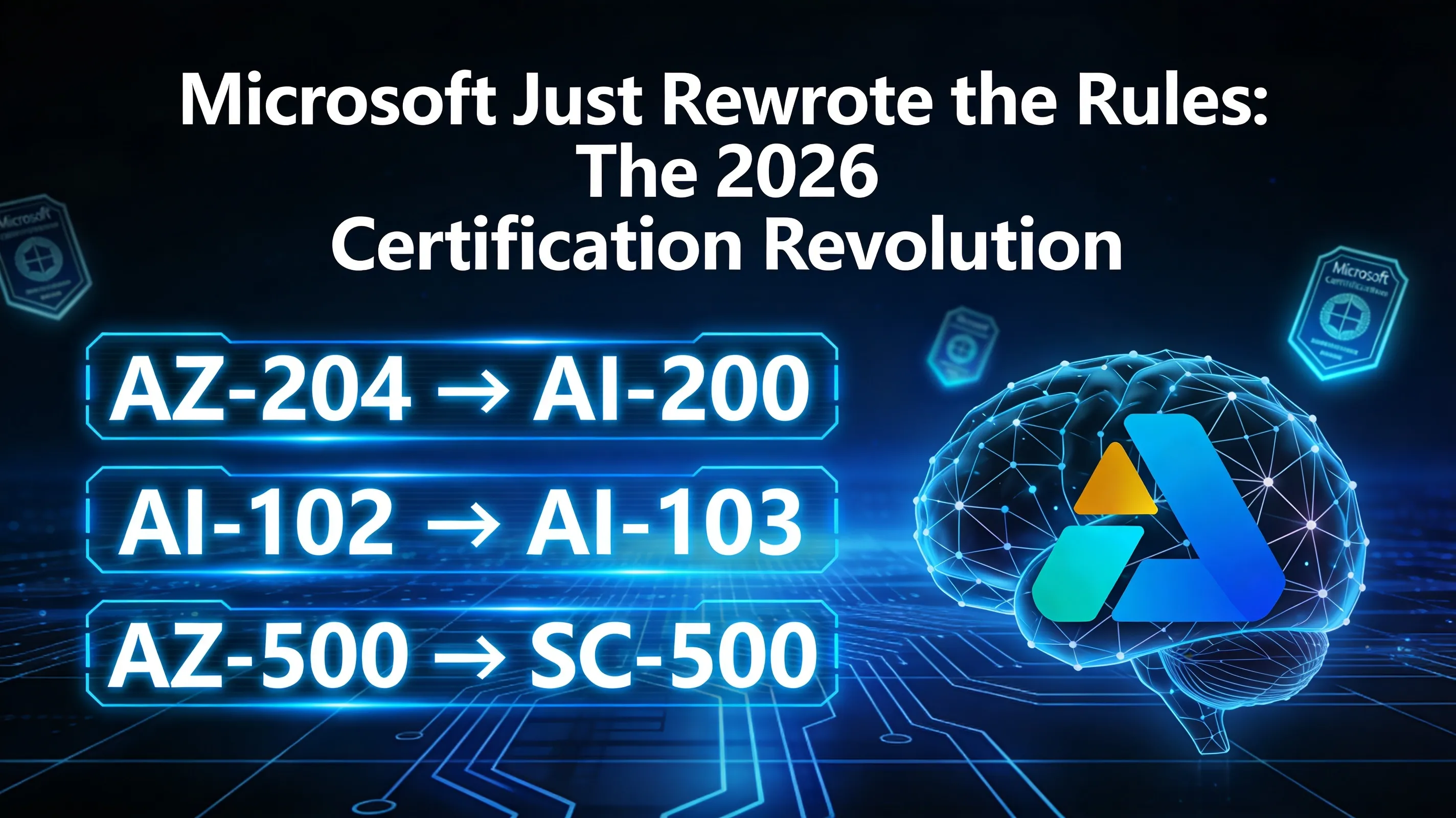
The cloud industry has been talking about AI transformation for years. Microsoft just made it official, not in a press release, not in a product announcement, but in the most direct way possible: by fundamentally redesigning what it means to be a Microsoft Certified Professional.
On March 6, 2026, Microsoft announced the retirement of 7 major certifications and the introduction of 9 new AI-focused credentials. This is not a cosmetic refresh. This is a structural overhaul of the entire certification roadmap, and if you’re a cloud professional, a developer, a security engineer, or a data scientist, this directly affects your career path, your study plan, and how you present your skills to the market.
Let me walk you through everything you need to know.
Why Microsoft Did This
For the past decade, Microsoft certifications have followed a clean role-based model: Azure Administrator Associate, Azure Developer Associate, Azure Security Engineer, Azure AI Engineer. Each certification mapped to a well-understood job function.
But job functions have shifted. The “Azure Developer” of 2024 is being asked to build RAG pipelines, integrate Large Language Models, deploy AI agents, and work with vector databases. Tasks that never appeared in the original AZ-204 exam blueprint. Meanwhile, security engineers are defending AI-powered environments, and data scientists are transitioning from model training to MLOps and production deployment.
Microsoft’s response is clear: AI competency is no longer a specialty track, it is the baseline expectation for every technical role. The 2026 certification overhaul embeds AI directly into the developer, security, data, and infrastructure paths. You no longer go sideways into an AI track. You move forward through an AI-native one.
The Full Retirement and Replacement Map
Here is the complete picture of what is changing:
| Retiring Certification | Exam | Retirement Date | Replacement Certification | New Exam |
|---|---|---|---|---|
| Azure Developer Associate | AZ-204 | July 31, 2026 | Azure AI Cloud Developer Associate | AI-200 |
| Azure AI Engineer Associate | AI-102 | June 30, 2026 | Azure AI App and Agent Developer Associate | AI-103 |
| Azure AI Fundamentals | AI-900 | June 30, 2026 | Azure AI Fundamentals (refreshed) | AI-901 |
| Azure Data Scientist Associate | DP-100 | June 1, 2026 | Machine Learning Operations (MLOps) Engineer Associate | AI-300 |
| Azure Security Engineer Associate | AZ-500 | August 31, 2026 | Cloud and AI Security Engineer Associate | SC-500 |
| Windows Server Hybrid Administrator | AZ-800 / AZ-801 | September 2026 | Windows Server Hybrid Administrator | AZ-802 |
Most training materials for retiring exams will be pulled before the exam retirement dates, in many cases as early as April or May 2026, so the window to finish existing paths is tighter than the exam dates suggest.
The Biggest Change: AZ-204 Becomes AI-200
The retirement of AZ-204 (Azure Developer Associate) and its replacement by AI-200 (Azure AI Cloud Developer Associate) is the change that will affect the largest number of professionals globally.
AZ-204 has been the defining certification for Azure developers for years. It validated a broad developer skill set: compute, storage, APIs, App Service, messaging, and security integration. It was comprehensive, well-respected, and well-supported by training material.
AI-200 keeps that foundation, but reframes everything through an AI-native lens. The new exam covers containerised applications, serverless architectures, and databases, but situates all of it within the context of building AI-enabled solutions. The name change from “Azure Developer” to “Azure AI Cloud Developer” is not branding, it is a statement of intent.
Concretely, AI-200 adds and emphasises:
- Building Generative AI applications on Azure
- Implementing Retrieval-Augmented Generation (RAG) patterns
- Developing and orchestrating AI agents
- Working with vector databases
- Integrating Microsoft Foundry and Azure OpenAI Service
- Designing AI-native application architectures
Beta exams and training for AI-200 were expected to be available in April 2026, with general availability in July 2026. Registration for AZ-204 closes on July 31, 2026, after that date, AI-200 is the only path forward.
What About Your Existing AZ-204 Certification?
If you already hold AZ-204, your certification remains valid until its original expiration date. Once it expires, it moves to the historical certifications section of your transcript. There is no transition exam or bridging path. To earn the new credential, you must take AI-200 from scratch.
AI-102 Evolves Into AI-103: Agents Take Center Stage
The AI-102 (Azure AI Engineer Associate) retires on June 30, 2026, replaced by AI-103 (Azure AI App and Agent Developer Associate).
This is arguably the most technically significant rename in the entire wave. The inclusion of “Agent” in the new title reflects how deeply agentic AI has moved from research into production. AI-103 signals that Microsoft expects certified AI professionals to be fluent in multi-agent orchestration, tool-calling patterns, and autonomous AI workflows, not just service configuration and model deployment.
For anyone working with Microsoft Foundry, Microsoft Agent Framework, this certification will become the gold standard credential to demonstrate that expertise.
DP-100 Becomes AI-300: The MLOps Pivot
The DP-100 (Azure Data Scientist Associate) retires June 1, 2026, replaced by AI-300 (Machine Learning Operations Engineer Associate).
This transition tells an important story about how the data science role is maturing in enterprises. The era of the lone data scientist building models in notebooks is giving way to an era of production-grade ML systems — where the work is about pipelines, deployment, monitoring, drift detection, retraining automation, and responsible AI governance.
AI-300 is the certification for the engineer who takes ML from experimentation to production at scale. If you’re working with Azure Machine Learning, MLflow, or GitHub Actions for ML pipelines, this is the credential path you’ll want to follow.
AZ-500 Becomes SC-500: Security Meets AI
The AZ-500 (Azure Security Engineer Associate) retires August 31, 2026, replaced by SC-500 (Cloud and AI Security Engineer Associate).
The addition of “AI” to the security engineer credential is deliberate. Securing AI workloads, protecting model endpoints, managing AI data pipelines, applying Zero Trust to AI-integrated architectures, and governing Copilot deployments — requires skills that AZ-500 never addressed. SC-500 bridges that gap.
If you are responsible for securing Azure environments that include AI services, Copilot integrations, or Azure OpenAI deployments, this transition should be at the top of your planning list.
The New Credentials That Didn’t Replace Anything
Beyond the retirement wave, Microsoft also introduced entirely new certifications in early 2026 that didn’t replace existing exams — they filled gaps that didn’t previously exist:
- AB-900 — Microsoft 365 Certified: Copilot and Agent Administration Fundamentals: Entry-level credential for IT professionals managing and securing Microsoft 365 Copilot and agent environments.
- AB-100 — Microsoft Certified: Agentic AI Business Solutions Architect: Expert-level certification for architects designing multi-agent AI solutions that integrate Copilot, Microsoft Foundry, and Dynamics 365. (Wait from news on this from my end, I will bring great news!!!)
- AB-730 — Microsoft Certified: AI Business Professional: For business professionals using generative AI and Copilot to improve workflows — no coding required.
- AB-731 — Microsoft Certified: AI Transformation Leader: Validates the ability to define AI business value and drive company-wide AI adoption.
The AB series is particularly interesting because it extends Microsoft certification beyond pure technical roles. AI fluency is now being certified at the business and leadership level — recognising that AI transformation requires informed decision-makers, not just skilled engineers.
What This Means for Your Career Strategy
The pattern across every change in this wave is consistent: AI is no longer adjacent to cloud, it is inseparable from it. Here is how to think about your next move:
If you hold AZ-204: You have until July 31, 2026 to renew it. But rather than renewing a cert that is being retired, evaluate whether your role demands AI-200 skills now. For most Azure developers in 2026, the answer will increasingly be yes.
If you are studying for AZ-204 now: Assess honestly whether you can complete and pass the exam before training materials are retired in May 2026. If not, pivoting to AI-200 content, when it becomes widely available.
If you hold AI-102: Your certification retires June 30, 2026. Begin tracking AI-103 beta availability and plan accordingly. Do not wait for the last moment.
If you hold DP-100: This has the earliest retirement, June 1, 2026. AI-300 is your path, and you should be acting now.
If you hold AZ-500: You have until August 31, 2026, but training retires earlier. Factor in how much of your current role involves AI-adjacent security scenarios to assess urgency.
The Bigger Picture
Microsoft is not just updating certification numbers. It is redefining what a qualified cloud professional looks like in the age of AI. Every role: developer, security engineer, data scientist, AI engineer, solutions architect is being redefined around AI-native competency.
The certifications that exist by the end of 2026 will tell the market that you don’t just know Azure, you know how to build, secure, and operate intelligent systems on Azure. That distinction will matter enormously in hiring, in project assignments, and in salary negotiations.
The window to prepare is open right now. The professionals who move early, understand the new exam domains, and build genuine hands-on experience with Microsoft Foundry, AI agents, RAG architectures, and MLOps pipelines will be the ones who come out of this transition ahead.
Microsoft just raised the bar. Time to clear it.
Have questions about how to plan your certification path for 2026? Reach out — I’m actively working with these technologies and happy to help you map out your next steps.