
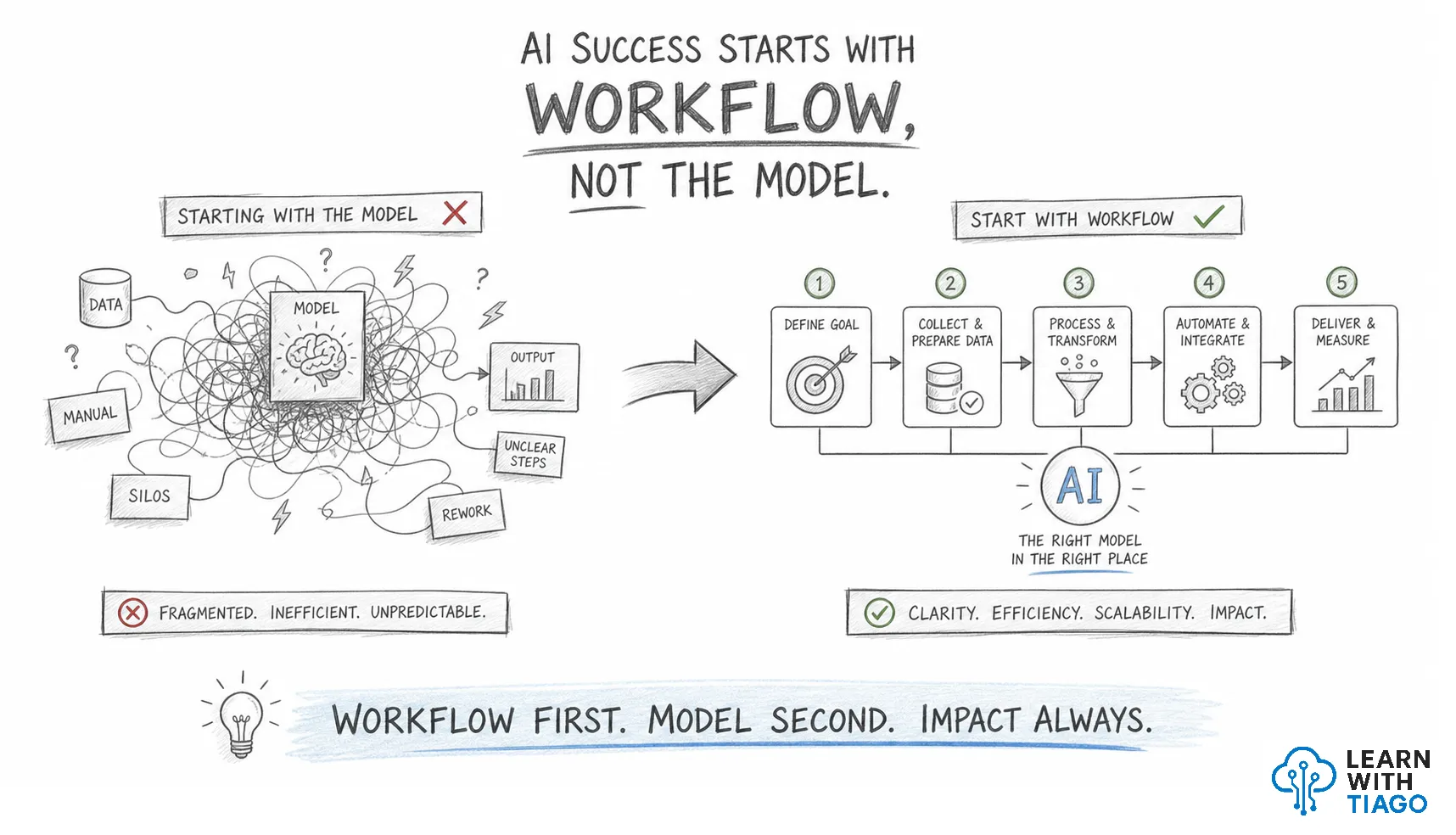
A lot of AI conversations begin in the wrong place.
We start by asking which model is best, which tool is newest, or which assistant gives the sharpest answers. Those are useful questions, but they are not the most important ones. In real projects, the first question should be much simpler: what workflow are we trying to improve?
That shift matters more than people think. If the underlying process is weak, AI will not magically fix it. In fact, it can make the weakness more visible. It may help you produce more output, but it will not necessarily help you produce the right output. Good AI design starts by understanding how work actually happens before adding intelligence on top of it.
Why Workflow Comes First
Every business process has friction. People repeat steps, copy information between systems, wait for approvals, search for context, and rework things that should have been right the first time. This is where AI can be powerful, but only if it is introduced with intention.
When you focus on the workflow first, you can identify the moments where AI genuinely helps. Maybe it reduces manual summarization. Maybe it helps triage requests. Maybe it improves search, drafting, classification, or decision support. The point is not to “add AI” everywhere. The point is to remove friction where the work is actually slowing people down.
This is why so many AI initiatives feel impressive in demos but underwhelming in practice. They are designed around the technology instead of the business problem. A good model can generate a response, but a good workflow makes that response useful.
AI can create a lot of output very quickly. That is part of its appeal. But more output does not automatically mean more value.
A team can use AI to generate emails, summaries, reports, and ideas all day long, but if those artifacts are not aligned with a clear process, they just add noise. Real value appears when AI fits naturally into a flow of work and helps people reach a better decision or a better result faster.
That is why architecture, governance, and process design matter so much. Before you ask whether a model is accurate enough, ask whether the task itself is well defined. Before you ask whether the prompt is strong enough, ask whether the workflow has clear inputs, owners, and outcomes. Those questions are less glamorous, but they are the ones that determine whether AI becomes useful or just decorative.
What This Looks Like in Practice
I’m going to use a real example at one of my customers. It’s a support team that spends hours reading incoming requests and deciding which ones need attention first. If you jump straight to the model, you might ask it to classify tickets. That may help, but only if the broader workflow is already clear.
You should ask some questions:
- What happens after classification?
- Who receives the ticket?
- What data does the system need?
- What should happen when the AI is uncertain?
- How is escalation handled? What is the human responsible for?
Those questions shape whether AI becomes a real improvement or just another layer of complexity.
The same idea applies to content creation, training, operations, and business analysis. AI works best when it supports a process that already has direction. It should help people move faster through a well-designed workflow, not force them to invent the workflow around the tool.
The Human Side Still Matters
One of the most important lessons from working with AI is that human judgment becomes even more valuable, not less. The model can generate text, summarize information, and suggest options, but it does not understand your business priorities the way people do.
That means the best AI systems are not the ones that replace people. They are the ones that free people from repetitive work so they can focus on context, strategy, and decisions. In other words, AI should take care of the parts of the job that are mechanical, while humans keep ownership of the parts that require judgment.
That balance is where the real opportunity is. When AI is designed around workflow, it becomes a practical force multiplier. When it is designed around novelty, it usually becomes a temporary experiment.
If you want AI to make a real difference, start by mapping the work. Look at where people spend time, where they make mistakes, where they wait, and where they repeat themselves. Then ask which of those steps can be improved with automation, assistance, or better decision support.
That approach is slower at the beginning, but it leads to much better results. It forces you to solve the right problem instead of chasing the latest trend. It also helps teams build trust, because the value is visible in the workflow itself rather than hidden inside a flashy demo.
That is the mindset I keep coming back to: the model matters, but the workflow matters more. If you get the workflow right, AI becomes useful. If you get the workflow wrong, even the best model will struggle.
Closing Thought
The most effective AI projects are rarely the ones that begin with “what can this model do?” They begin with “what problem are we trying to solve?” That question sounds simple, but it changes everything.
Once you start there, the technology becomes easier to choose, easier to explain, and easier to adopt. And that is usually where the real value appears.