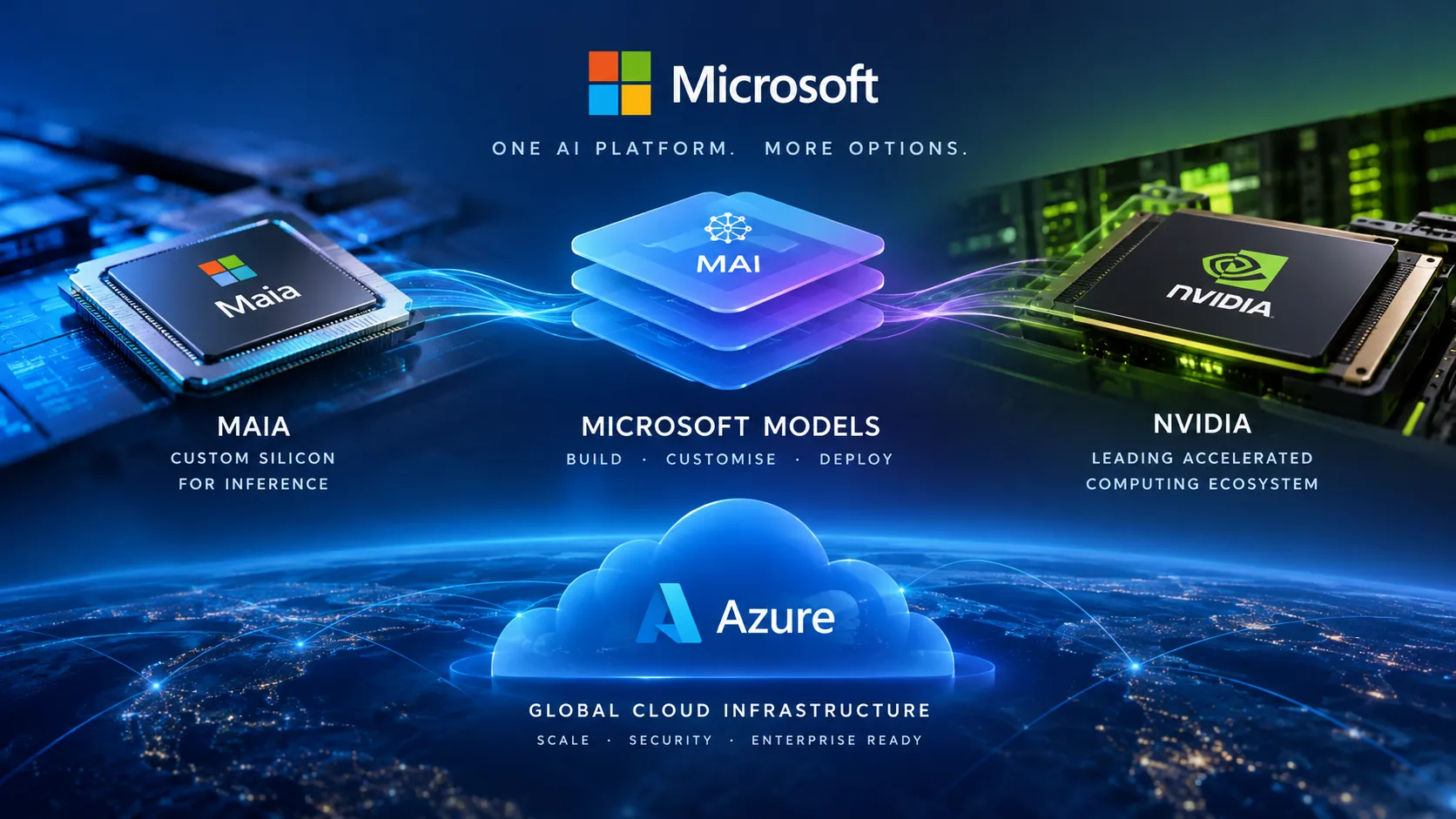
Microsoft isn’t trying to win the AI race with a single chip or a single model. It’s building a strategy that gives it control over more of the AI stack while keeping NVIDIA firmly in the picture. When Microsoft announced plans to scale its Azure Maia accelerator family to multi-gigawatt deployments starting in 2027, the headline was about AI chips, but I think the more interesting story is what this announcement tells us about Microsoft long-term AI strategy.
Microsoft is building its own AI models. It is designing its own AI silicon. It operates one of the world’s largest cloud platforms, and at the same time, it continues to invest in its strategic partnership with NVIDIA.
At first glance, these moves might seem contradictory. Why build your own AI accelerators if you’re partnering with NVIDIA? Why invest in your own models when you have access to leading models from other AI companies like OpenAI and Anthropic?
I believe the answer is that Microsoft wants to control the economics and architecture of AI without limiting itself to a single technology provider. And this can become one of its most important competitive advantages. Let me analyse this in 7 points:
1. Controlling the AI stack
The AI industry has spent years focusing on the capabilities of individual models. Which model reasons better? Which produces better code? Which can process more context? Those questions still matter, but the economics of AI are becoming more important.
As AI moves from niche usecases into everyday business applications, millions of users and agents will generate enormous volumes of inference requests. Every interaction consumes computing resources. Every agent that reasons, calls a tool, evaluates the result, and continues working generates additional demand.
At Microsoft scale, small improvements in inference efficiency can have substantial consequences for infrastructure capacity and operating costs. This is where Microsoft strategy starts to make sense.
Consider the layers Microsoft is bringing together:
- Cloud infrastructure: Azure provides the datacentres, networking, storage, and global distribution.
- Custom silicon: Maia is designed around the inference workloads Microsoft expects to run at scale.
- AI models: Microsoft MAI family gives it models it can develop and optimise itself.
- External AI models: Microsoft continues to support models from OpenAI, Antropic and other providers.
- Applications and agents: Copilot, GitHub Copilot, Microsoft 365, and enterprise AI services turn that infrastructure into products customers use.
The important point is not that Microsoft owns every layer. It doesn’t need to, it is that Microsoft can increasingly optimise the layers it controls while retaining access to the wider AI ecosystem. This strategic creates flexibility, and flexibility matters in an industry evolving as quickly as AI.
2. Maia: Microsoft wants to change the economics of inference
Training frontier AI models attracts enormous attention, but inference is where the ongoing cost of serving those models becomes a daily operational concern. Who never read a story online of an organization that had a developer burning thousands of tokens in a very short period of time?
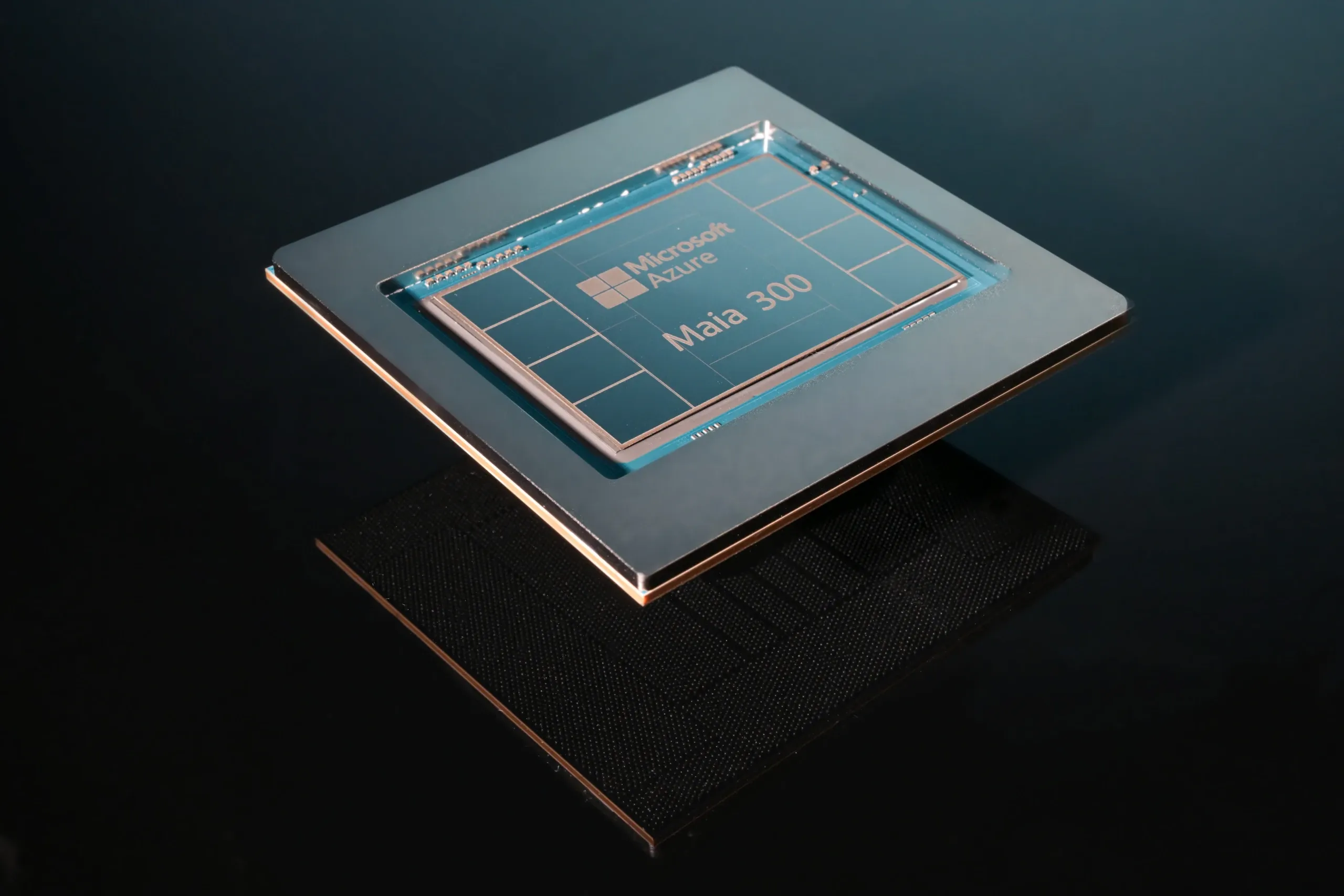
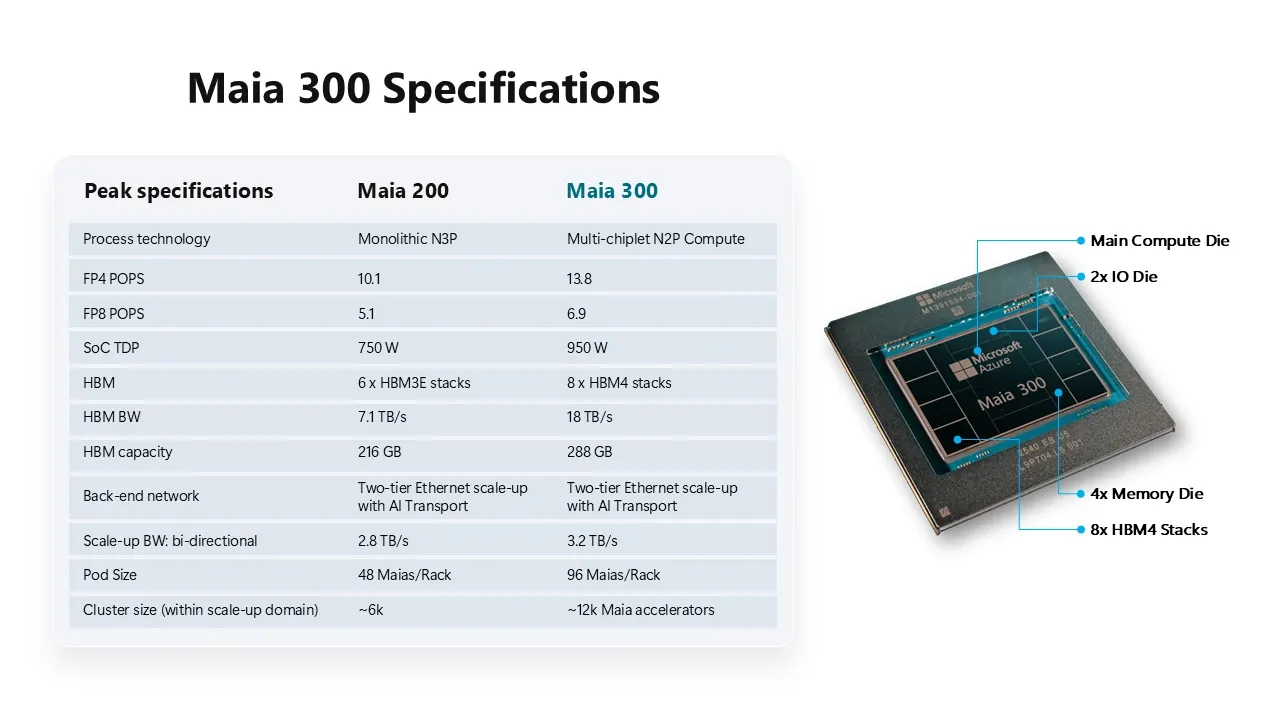
Microsoft strategy with Mais is increasingly focused on this problem. The company says Maia 200 is already serving production workloads, including Microsoft Copilot, and supporting its MAI model development. Microsoft plans to make Maia its primary inference system for its products and services as it scales deployments from 2027.
For Maia 300, Microsoft expects up to 40% more tokens per megawatt than leading GPU-based systems. These are Microsoft’s stated performance expectations, not a guarantee that every workload will achieve the same improvement.
If Microsoft can serve more tokens within a constrained power envelope, it has the potential to serve more requests using the same amount of power. That could help it expand capacity, improve the economics of its own AI services, and support workloads that would otherwise be more expensive to operate. The benefits are not automatic. Hardware development, software optimisation, utilisation, manufacturing capacity, and deployment costs all matter, but the opportunity is significant.
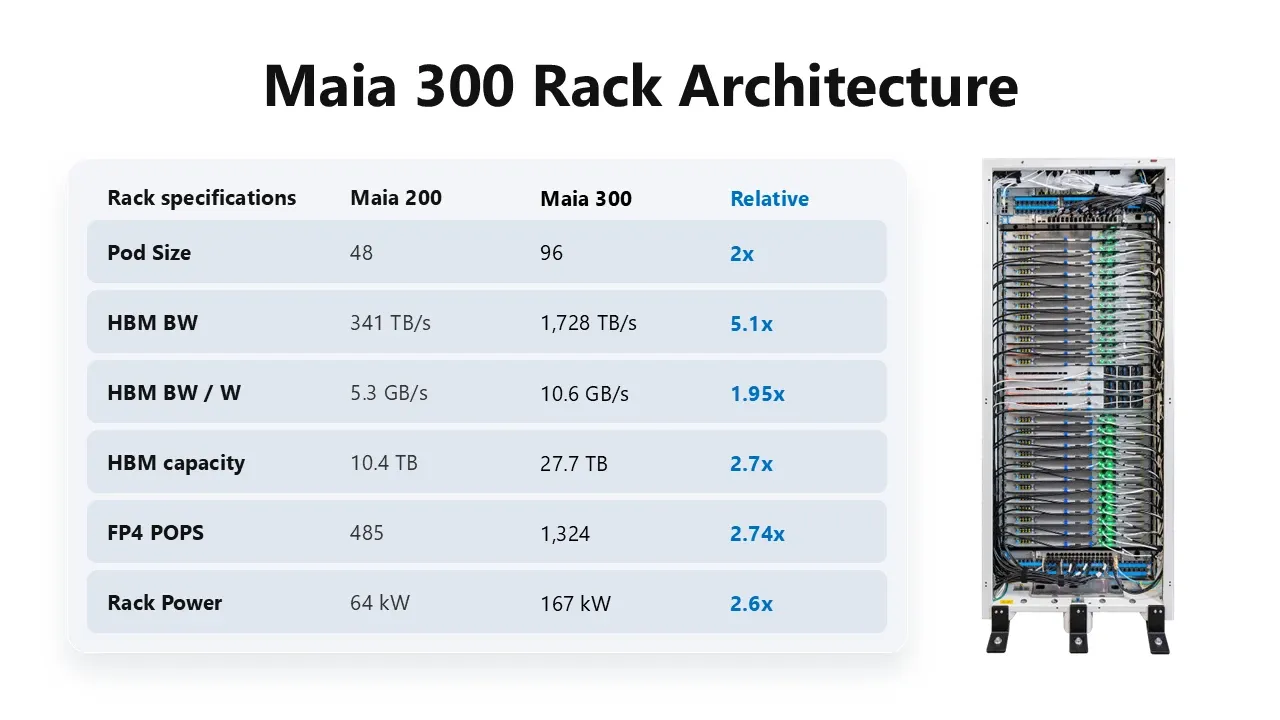
Take not of this: Maia is not simply an attempt to build a cheaper GPU. It is an attempt to optimise an entire inference system around Microsoft’s workloads. This includes the accelerator, memory, networking, software, racks, cooling, and datacentre design. At Azure scale, the system matters more than any individual component.
3. Microsoft own models create a powerful feedback loop
Microsoft is investing in its MAI model family across areas including reasoning, coding, image generation, voice, and transcription. Owning these models gives Microsoft more control over how they are developed, deployed, and optimised. It also creates opportunities to design models and infrastructure together rather than treating them as independent products. Verticalization can become a massive advantage at scale!
Microsoft observes the real-world performance and cost of its AI workloads. Its model teams identify opportunities to improve inference efficiency. Its hardware teams use those insights to refine the accelerator architecture. The improved infrastructure then allows the teams to test and deploy new models at scale. Each iteration can inform the next. This is a feedback loop between hardware, models, software, and real production workloads.
This is even more relevant for inference because the best design depends on what the models actually do. A workload dominated by long-context processing may have different requirements from one focused on rapid token generation or multi-step agent execution. Microsoft’s Maia programme gives it an opportunity to optimise for those specific requirements. There is another strategic benefit: Microsoft can develop and deploy its own models without relying exclusively on the commercial terms, roadmaps, or infrastructure choices of external model providers.
4. Why NVIDIA still matters
Microsoft is building its own AI accelerators, yet it continues to work closely with NVIDIA.
Why not simply replace NVIDIA with Maia? NVIDIA brings more than GPUs. Its accelerated computing platform includes mature software, development tools, libraries, networking technologies, and a broad ecosystem of AI frameworks and applications. That ecosystem is an important part of why NVIDIA remains central to AI infrastructure.
Microsoft also needs the flexibility to support a wide variety of customer workloads, models, and infrastructure requirements. Not every workload will be best served by the same accelerator.
Its relationship with NVIDIA therefore remains strategically valuable even as Microsoft expands its own silicon programme. The partnership extends beyond buying hardware. Microsoft and NVIDIA have also worked together on AI infrastructure, model availability, enterprise AI, and the tools developers use to build and deploy AI applications.
The strategic interpretation is straightforward: Microsoft can use NVIDIA where its platform and ecosystem provide the most value, while using Maia where Microsoft’s own workload characteristics make custom inference infrastructure attractive.
5. The strategic advantage: choice
Combining its own silicon, its own models, and NVIDIA’s platform gives Microsoft several potential advantages.
More control over cost
Microsoft can optimise inference infrastructure around its own workloads instead of relying exclusively on third-party accelerator roadmaps. If Maia delivers its expected efficiency gains in production, Microsoft could improve the economics of serving its own AI services.
Less dependence on a single supplier
Custom silicon gives Microsoft an additional source of computing capacity and more flexibility in how it allocates workloads. It does not eliminate dependence on external suppliers. Maia still relies on a complex semiconductor supply chain, and Microsoft continues to need partners across the industry. The benefit is diversification, not complete independence.
Faster hardware and software co-design
When the hardware and model teams work together, they can optimise for each other’s requirements. This can influence memory usage, numerical precision, model architecture, data movement, and inference execution.
More options for customers
Microsoft’s broader AI strategy is not about forcing every workload onto one model or one accelerator. Azure and Microsoft Foundry can support multiple model families, while Microsoft’s own silicon expands the infrastructure options available to its services.
That combination can help Microsoft offer different balances of capability, latency, cost, and deployment flexibility. Taken together, these advantages could make Microsoft’s AI platform more competitive over time.
6. What this means for Microsoft’s relationship with OpenAI?
Microsoft has built a significant AI business around its relationship with OpenAI. Access to OpenAI’s models has been an important part of its AI offering, but Microsoft is also developing its own MAI models and building infrastructure that can run multiple model families.
Microsoft continue to offer OpenAI models where they provide value, develop its own models for selected workloads, and support other providers when they better fit a customer’s needs.
The company can compete at the model layer in some areas while continuing to partner with external model developers in others. That is not necessarily a retreat from partnerships. It is a way to reduce the risk of making the entire AI strategy dependent on the success of one model family.
As a customer myself, I like to select an hyper-scaler that gets me access to capable models, but they also the flexibility as models evolve and their requirements change. A cloud platform that can combine multiple models with a choice of infrastructure has more ways to meet those requirements.
7. Microsoft is building an AI platform, not just an AI business
The most important part of this announcement is what it reveals about Microsoft ambitions. Microsoft is not simply trying to sell AI models, rent GPUs, or add Copilot features to existing products.
It is building an integrated platform spanning cloud infrastructure, custom silicon, AI models, development tools, enterprise services, and end-user applications, where each layer can strengthen the others.
Azure provides the scale to deploy the infrastructure. Maia creates opportunities to optimise inference. MAI gives Microsoft more control over its model roadmap. NVIDIA provides access to a mature accelerated computing ecosystem. Microsoft’s applications create demand for all of these capabilities.
This is a potentially powerful position because Microsoft can learn from its own production workloads and use those insights to improve the platform.
However, there are significant challenges. Custom silicon must deliver on its promised efficiency. Microsoft must continue to secure manufacturing capacity and deploy infrastructure at scale. Its own models must remain competitive for the workloads they target. And the company must keep supporting the diverse needs of Azure customers.
Strategic control does not guarantee technical leadership. But it gives Microsoft more ways to pursue it.
Microsoft wants to choose where it competes
My biggest takeaway from this announcement is that Microsoft appears to be pursuing a deliberate balance between owning critical parts of the AI stack and partnering across the wider ecosystem. Maia gives Microsoft a path to optimise inference infrastructure. MAI gives it more control over model development. NVIDIA gives it access to a broad and mature accelerated computing platform.
These investments are complementary rather than necessarily contradictory. The real test will be whether Microsoft can turn them into measurable advantages in performance, cost, reliability, and customer value. If it succeeds, Microsoft will be in a position to decide which workloads run on its own silicon, which benefit from NVIDIA’s platform, which models it develops itself, and which it obtains from partners. That is a much stronger strategic position than depending on a single model provider or a single hardware architecture.
The most interesting question isn’t whether Maia will replace NVIDIA. It’s whether Microsoft can use Maia, MAI, and NVIDIA together to make Azure a more efficient and more flexible platform for AI. And if Microsoft can make that combination work at multi-gigawatt scale, the implications will extend well beyond a new generation of AI chips.