There is one pattern I keep seeing again and again in cloud and AI projects: teams still depend too much on manual clicks in the portal. At first, it feels efficient. You need to test something quickly, change a setting, or move fast to unblock a project. A few clicks later, the job is done. But the problem is that click-ops does not scale well. It creates inconsistency, makes reviews harder, increases the chance of human error, and usually leaves security and operational quality behind. In DevOps and cloud environments, those weaknesses become expensive very quickly.
Manual changes are hard to reproduce. If one person configures a resource one way today and another person does it differently tomorrow, you now have drift. That drift is not just a technical annoyance. It affects governance, security, troubleshooting, and compliance. When the environment changes through the portal instead of through code, it becomes much harder to know what changed, when it changed, and why it changed. This is especially risky in cloud projects that are supposed to move fast. Teams often think speed and control are opposites. In reality, the best way to move fast safely is to automate the secure path.
The security angle
Security should not be something you add later. If it is not built into the deployment path, it usually becomes a manual exception, and manual exceptions do not age well. A few common issues show up repeatedly in cloud and DevOps work: hardcoded secrets, weak pipeline controls, poor environment separation, and permissions that are broader than they need to be. None of those problems get better because someone clicked carefully in a portal. Automation helps because it creates repeatable guardrails. Policies, approvals, identity controls, secret management, and pipeline checks can all enforce a baseline that humans do not need to remember every time.
The DevOps angle
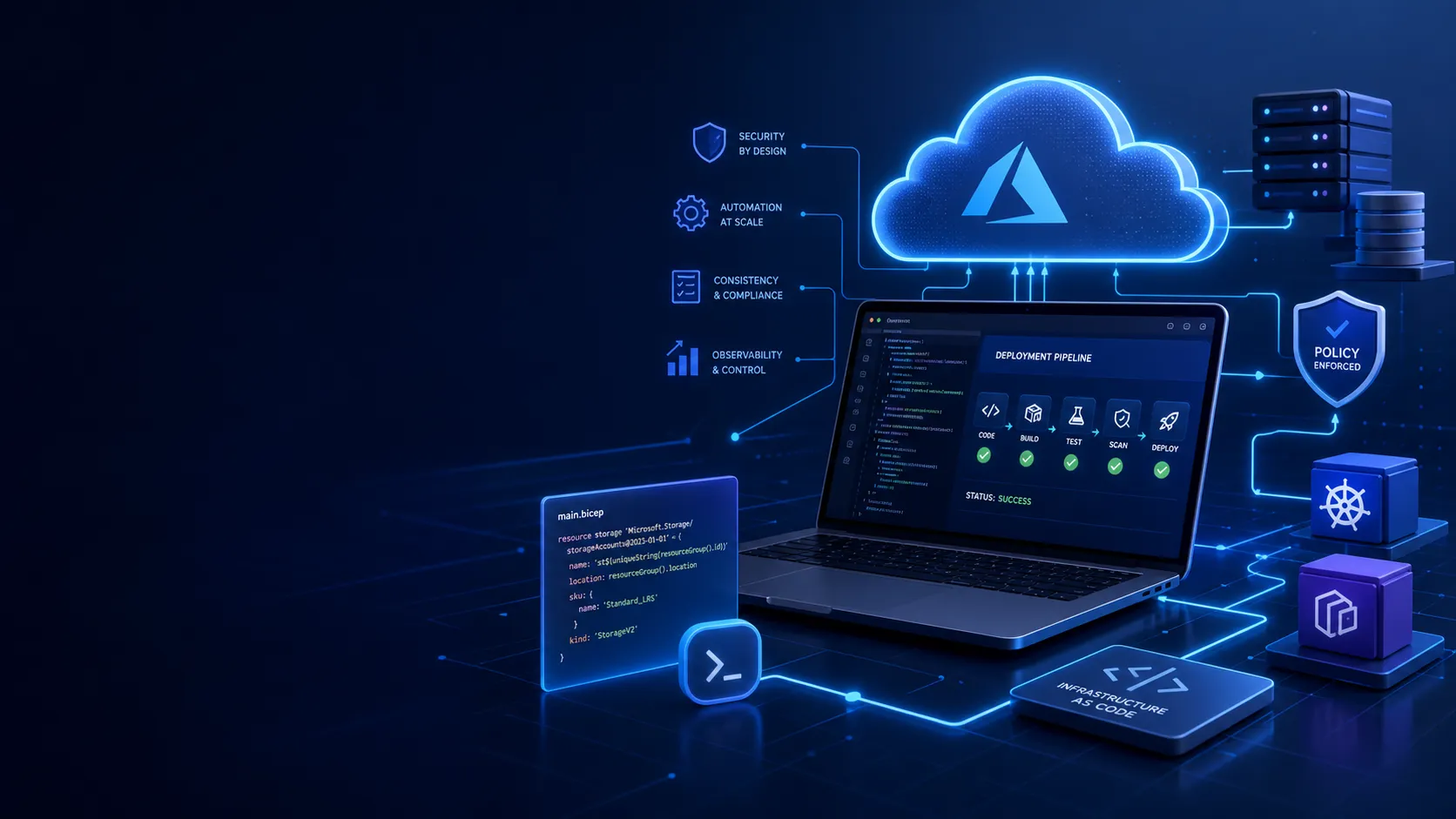
DevOps is not just about deploying faster. It is about making delivery reliable, repeatable, and observable. That means infrastructure should be treated as code, not as a one-off manual setup. It also means your pipeline should be the normal path to change, not an optional extra that only some teams use when they have time. Manual deployments, undocumented environment changes, and inconsistent release steps all slow teams down in the long run. A good DevOps process reduces friction by standardizing the things that should not be improvised. Build, test, scan, approve, deploy, and monitor should be part of a repeatable workflow. When that happens, teams spend less time recovering from mistakes and more time shipping useful work.
What to automate first
You do not need to automate everything at once. Start with the areas that cause the most risk and repetition.
- Infrastructure deployment.
- Identity and access provisioning.
- Secret handling and rotation.
- Policy enforcement.
- Environment setup and teardown.
- Security scanning in CI/CD.
- Basic compliance checks.
- Rollback and recovery steps.
If a task is repeated often, affects production, or depends on memory, it is a strong candidate for automation. If a task is security-sensitive, it is an even stronger candidate.
A healthier cloud model is simple: define the secure standard once, then reuse it everywhere. This usually means using infrastructure as code (IaC), CI/CD pipelines, policy-as-code, and clear separation between environments. It also means removing unnecessary portal work from the normal delivery path and keeping manual intervention only for exceptional cases. This approach improves consistency and reduces surprises. It also makes audits, troubleshooting, and handovers much easier because the system is documented in code and pipeline history rather than in screenshots and tribal knowledge.
What good looks like
The goal is not “no human involvement.” The goal is to move human effort to the right place. Humans should design the controls, review the architecture, define the standards, and improve the process. Automation should handle the repetitive execution. That is where the combination of security and DevOps becomes powerful. When automation is done well, the result is not just faster delivery. It is better delivery. Safer delivery. More predictable delivery.
Final thought
The biggest mistake is not using the portal, the biggest mistake is letting the portal become the operating model. If your team still depends heavily on manual changes, now is a good time to ask one question: what should be done by code, by pipeline, or by policy instead of by clicks? That question alone can improve security, reliability, and team velocity at the same time.