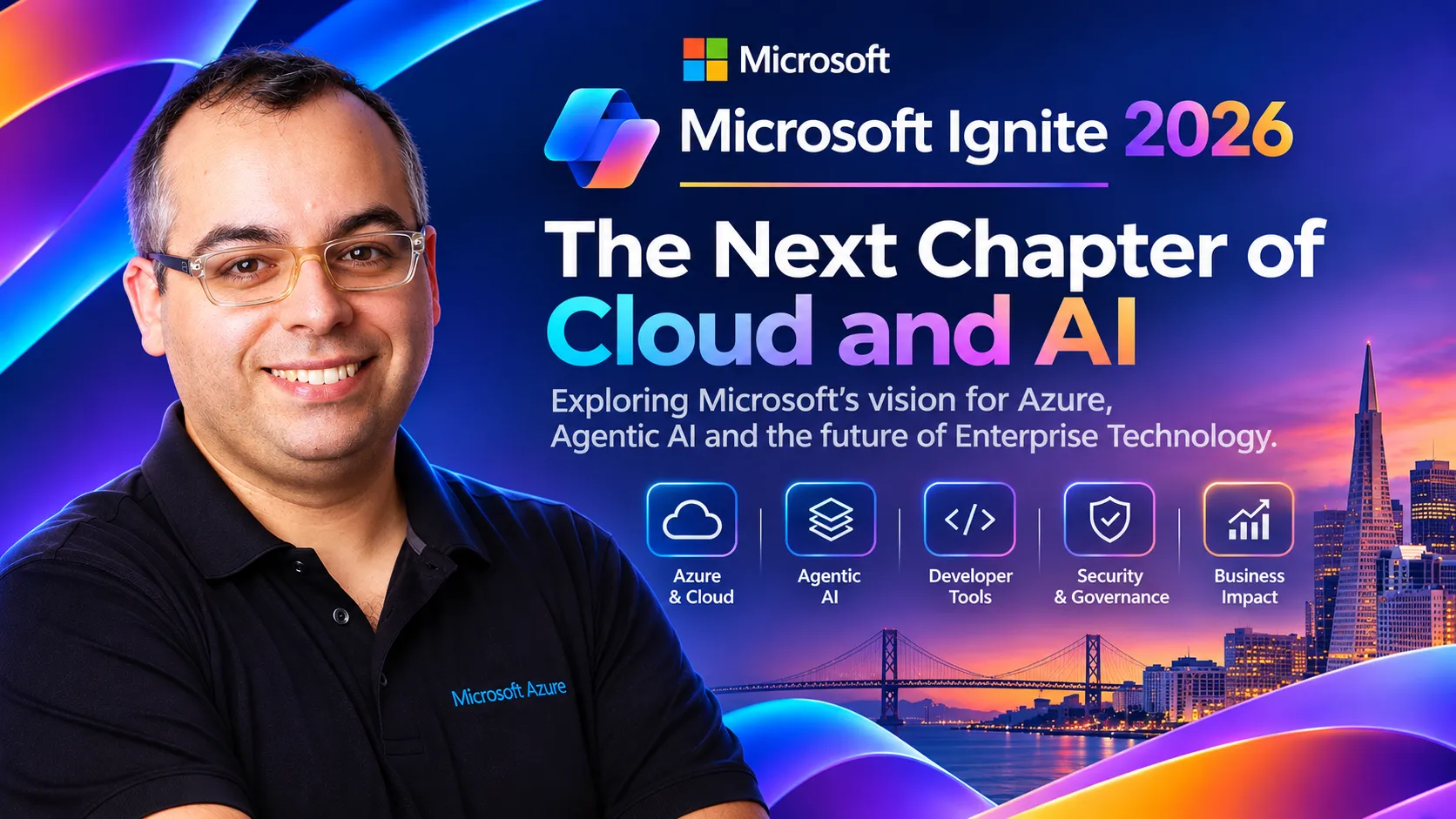
What Microsoft’s direction means for the future of Cloud, AI and Enterprise Technology.
Microsoft Ignite 2026 starts tomorrow, November 17, bringing together technology professionals, developers, IT leaders, business decision-makers and partners in San Francisco and online.
Every year, Ignite gives us an opportunity to understand where Microsoft is investing, which technologies are maturing and what direction the company wants its customers and partners to follow.
But I think this year’s event deserves a slightly different perspective.
We’ve spent the last few years exploring generative AI, experimenting with Copilots and discovering what large language models can do. We’ve seen an incredible pace of innovation, with new products, services and capabilities appearing almost every month.
However, the conversation is changing.
We’re moving from asking what AI can tell us to asking what AI can actually do. From assistants that help us complete tasks to agents that can execute workflows, interact with enterprise systems and make decisions within defined boundaries.
This transition has significant implications for how we design cloud architectures, develop applications, manage identities, protect data and govern technology.
As someone who has spent many years working with Microsoft Azure and helping organisations design and implement cloud solutions, I’m particularly interested in understanding how Microsoft intends to connect these developments into a coherent enterprise platform.
I’m not looking only for new features or impressive demonstrations. I’m looking for answers to some more fundamental questions:
- Are we getting closer to making agentic AI genuinely useful in enterprise environments?
- Is Azure evolving fast enough to become the foundation for this new generation of applications?
- How will organisations manage security, identity and governance when AI agents become active participants in their environments?
- What does this mean for developers, architects and IT professionals?
- And perhaps most importantly, how much of this innovation can organisations realistically put into production?
These are the questions I want to explore during Microsoft Ignite 2026.
The sessions I want to follow
While preparing for Ignite, I went through the official Microsoft Ignite session catalogue. I found several sessions that are particularly relevant to the audience we’re targeting.
I don’t want to include sessions simply because they have interesting titles. I want to use them to identify the questions and themes that deserve attention throughout the event.
1. Agentic AI and Microsoft Foundry
One of the areas I’m most interested in exploring is the evolution of Microsoft’s agent development platform.
I want to understand how Microsoft Foundry is becoming a platform for building, deploying, evaluating and operating enterprise agents.
The important questions are how agents are deployed, monitored, evaluated, secured and operated at scale, and how easily they integrate into existing enterprise architectures.
I’m particularly interested in:
I want to understand whether Microsoft Foundry is becoming a genuinely complete enterprise agent platform, rather than simply another place to access models and build prototypes.
Building an agent is one thing. Operating hundreds or thousands of agents in production, with appropriate security, monitoring and governance, is an entirely different challenge.
2. Azure and the cloud architecture behind AI
One of my biggest interests is understanding how the architecture of cloud applications will change.
We have spent years designing applications around microservices, containers, APIs and event-driven architectures. Will agentic applications require a new architectural approach, or will existing cloud-native principles remain relevant with new capabilities layered on top?
I’m particularly interested in how Azure App Service, Azure Container Apps and Azure Functions will support this new generation of applications.
I also want to explore the infrastructure requirements behind enterprise AI: compute, networking, storage, security and orchestration.
Two sessions stand out:
- Build AI-native with Azure’s agentic application platform
- Model to mission: Azure Infra for agentic enterprise
The second session is particularly interesting because it looks at the infrastructure required to move AI from experimentation into enterprise operations.
For Azure architects, this is an important area to watch. We need to understand not only how to build AI-powered applications, but also how to make them reliable, scalable, secure and cost-effective.
3. The evolution of software development with GitHub Copilot
GitHub Copilot has already changed how many developers write code. But the next step is much more interesting: agents that can work with repositories, interact with tools, execute development tasks and participate in software engineering workflows.
I want to understand how Microsoft and GitHub are approaching the transition from AI-assisted coding to agent-driven software engineering.
Two sessions are particularly interesting:
- Hack the harness: Customize and secure GitHub Copilot SDK agents
- Unlock more value from your business apps with GitHub Copilot SDK
I’m particularly interested in the GitHub Copilot SDK and its potential to bring agent capabilities into existing applications.
However, increased development speed doesn’t automatically mean better software.
Code quality, testing, architecture, security reviews and maintainability remain essential. In fact, they could become even more important when the volume of AI-generated code increases.
4. Security, identity and governance cannot be an afterthought
I believe security and governance could become the biggest challenges to enterprise agent adoption.
An agent might have access to corporate information, execute operations, interact with APIs and perform actions on behalf of an employee or organisation.
That introduces questions around identity, authorisation, least privilege, auditability and accountability.
We already have established approaches for managing human identities, applications and workloads. But what happens when organisations have hundreds or thousands of agents, each with different permissions, responsibilities, tools and access to business data?
I want to understand how Microsoft Entra, Defender, Purview and Agent 365 fit together to address these challenges.
Some sessions I would prioritise:
- When AI acts, security has to answer: Microsoft Security for AI
- Build, secure and govern agents across platforms with Agent 365 and Entra
- Observability at every layer for every role
The interesting question isn’t whether we can build agents. It’s whether we can build agents that organisations can trust.
How do we know what they are doing? Who owns them? Who is accountable when something goes wrong?
These are architectural and governance questions, not simply product questions.
5. Copilot and the future of productivity
I also want to understand how Microsoft’s productivity ecosystem will evolve.
Copilot has already introduced AI into everyday applications, but the opportunity goes beyond generating text, summarising documents or creating presentations.
Can agents understand business context, connect workflows and help complete entire business processes?
One session I want to follow is:
I’m interested in seeing whether Microsoft can make Copilot more than an assistant that helps people create content. Can it become a genuinely useful collaborator that understands context, connects workflows and helps complete business processes?
What I think Microsoft needs to demonstrate
Looking at the sessions and the broader direction of the event, there are five areas where I will be paying particular attention.
From AI experimentation to enterprise adoption
We’ve seen plenty of impressive AI demonstrations. We’ve built prototypes, experimented with agents and integrated language models into applications.
But building a working prototype is very different from running an AI-powered application in production.
Enterprise adoption requires reliability, observability, security, scalability, predictable costs and clear ownership.
I want to see how Microsoft is connecting the development experience in Foundry with the operational capabilities required to run agents at scale.
In particular, I will be looking for answers around evaluation, tracing, monitoring, deployment strategies and the ability to measure the actual business value of agents.
Azure’s role in the agentic era
Azure has traditionally been the foundation for hosting applications, managing infrastructure, connecting services and delivering enterprise workloads.
But agentic applications introduce new requirements.
They need access to models, enterprise data, APIs, tools and external systems. They need secure execution environments, orchestration mechanisms and the ability to scale dynamically.
I am particularly interested in how Microsoft positions its application platforms and Microsoft Foundry within this new architecture.
Will Microsoft provide a coherent platform for building and operating agentic applications, or will organisations still need to assemble multiple independent services?
This is an important distinction for architects making long-term technology decisions.
Security must evolve alongside AI
The introduction of autonomous agents changes the security conversation.
We need to think about non-human identities, delegated permissions, access to sensitive data, tool execution and agent lifecycle management.
I want to understand how Microsoft is approaching these challenges and whether its security ecosystem can provide the controls necessary for enterprise adoption.
The future of software development
We are moving towards development environments where multiple agents can work on different tasks, understand repositories, execute workflows and collaborate with developers.
This could fundamentally change software engineering practices.
However, we must not confuse faster code generation with better engineering.
Architecture, testing, maintainability and security remain essential.
Business value, not just technology adoption
Finally, I want to see more evidence of measurable business outcomes.
Organisations don’t need another AI initiative simply because AI is the current technology trend.
They need solutions that reduce operational costs, improve productivity, accelerate processes, improve customer experiences or create new business opportunities.
The real test for Microsoft will be demonstrating how its technologies help organisations achieve those outcomes.
Microsoft’s bigger strategic picture
One thing that stands out when looking at the Ignite programme is the way Microsoft has organised its themes.
Agentic Business Applications, Agent Platform, Cloud & AI, Copilot, Security and Frontier Transformation are not isolated technology subjects.
They suggest a broader strategy in which Microsoft wants to connect the entire technology stack:
- Infrastructure to provide the compute and services required for AI.
- Platforms to build, deploy and operate agents.
- Data services to provide context and knowledge.
- Developer tools to accelerate application development.
- Productivity tools to bring AI into everyday work.
- Security and governance to control the resulting ecosystem.
This is the strategic picture I want to understand better during Ignite.
If Microsoft gets this right, it could create a powerful proposition for organisations already invested in its ecosystem.
But there is also a challenge: complexity.
More services, more agents, more integration points and more licensing options can make enterprise architectures harder to manage.
The opportunity is enormous, but Microsoft will need to demonstrate that it can simplify the experience rather than simply expand its portfolio.
What should organisations be thinking about already?
Regardless of what Microsoft announces tomorrow, I believe there are several areas organisations should already be considering.
First, revisit your AI strategy. Don’t treat AI as a collection of isolated Copilot deployments or experimental projects. Think about how AI capabilities fit into your applications, processes and overall technology strategy.
Second, prepare your architecture. Understand how your existing cloud platforms, data services, APIs and integration mechanisms can support AI-powered applications and agents.
Third, rethink identity and security. Start considering how non-human identities, agent permissions, data access and lifecycle management will work in your environment.
Fourth, invest in developer capabilities. AI-assisted development and agent-driven engineering will increasingly influence how software is built, tested and maintained.
Finally, measure outcomes. Technology adoption should be connected to business value. More agents don’t necessarily mean more productivity.
These are not necessarily actions that require waiting for Ignite announcements. They are strategic considerations that will become increasingly important as the technology evolves.
What happens next?
Tomorrow, the Microsoft Ignite opening keynote will give us the first major opportunity to understand Microsoft’s priorities for the coming year.
Satya Nadella and Judson Althoff will unveil Microsoft’s latest innovations, and I expect the keynote to provide important signals about the company’s direction.
But I don’t want to draw conclusions based solely on keynote announcements.
Over the following days, I want to look beyond the headlines, explore the technical sessions, understand the architecture behind the announcements and evaluate what is genuinely useful for organisations.
I will be particularly interested in separating three things:
- Innovation: What is Microsoft introducing that genuinely changes what’s possible?
- Readiness: What can organisations realistically deploy and operate today?
- Impact: What difference will these capabilities make to businesses, developers and IT professionals?
My expectations going into Microsoft Ignite 2026
I’m genuinely excited about this year’s Ignite.
Not simply because of the number of AI announcements we might see, but because I believe we are approaching an important transition in enterprise technology.
AI is moving beyond the experimentation phase. Agents are becoming part of application architectures, developer workflows and business processes. Cloud platforms need to evolve to support them, and security and governance need to keep pace.
For Azure architects and IT professionals, this represents an opportunity to rethink how we design, build and operate technology.
But excitement should not replace critical thinking.
We need to understand the limitations, costs, operational challenges and security implications just as much as the new capabilities.
My goal over the next few days is to understand whether Microsoft is providing the foundations to make this transition practical, secure and valuable for organisations.
Let’s see what Microsoft has prepared for us.
Microsoft Ignite 2026 starts tomorrow. I’ll update this article throughout the event with the announcements, technical developments and personal takeaways that I believe matter most.
Useful links